
Check out promising open-source texture-creation tool Material Maker

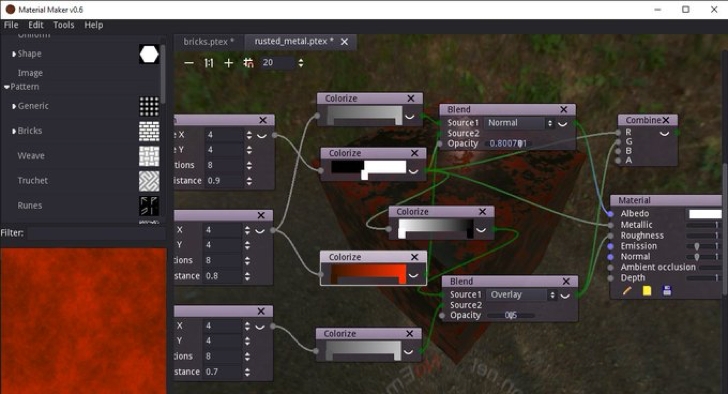
Neat new app authors PBR texture maps via a Substance Designer-like nodal workflow.
Blender has a powerful node-based editor for creating 3D shaders, but when it comes to authoring 2D texture maps, many artists turn to commercial tools like Adobe’s Substance Designer. What if there were a way to create those textures in an open-source application? Thanks to Material Maker, a promising – and recently updated – procedural texture-generation tool, there may be.
An open-source alternative to Substance Designer?
First released last year, Material Maker is described by its creator, ‘Rod Zilla‘, as a “simple procedural texture generation tool” based on the open-source Godot game engine.
Its workflow is reminiscent of a stripped-down version of Substance Designer, enabling users to create procedural textures by dragging readymade nodes from a library panel into the software’s graph editor, then wiring their inputs and outputs together to create procedural textures.
As of the latest update, Material Maker 0.6, each node can display a thumbnail image of the resulting 2D texture map, but you can also view the results applied to a mesh in the built-in 3D preview.
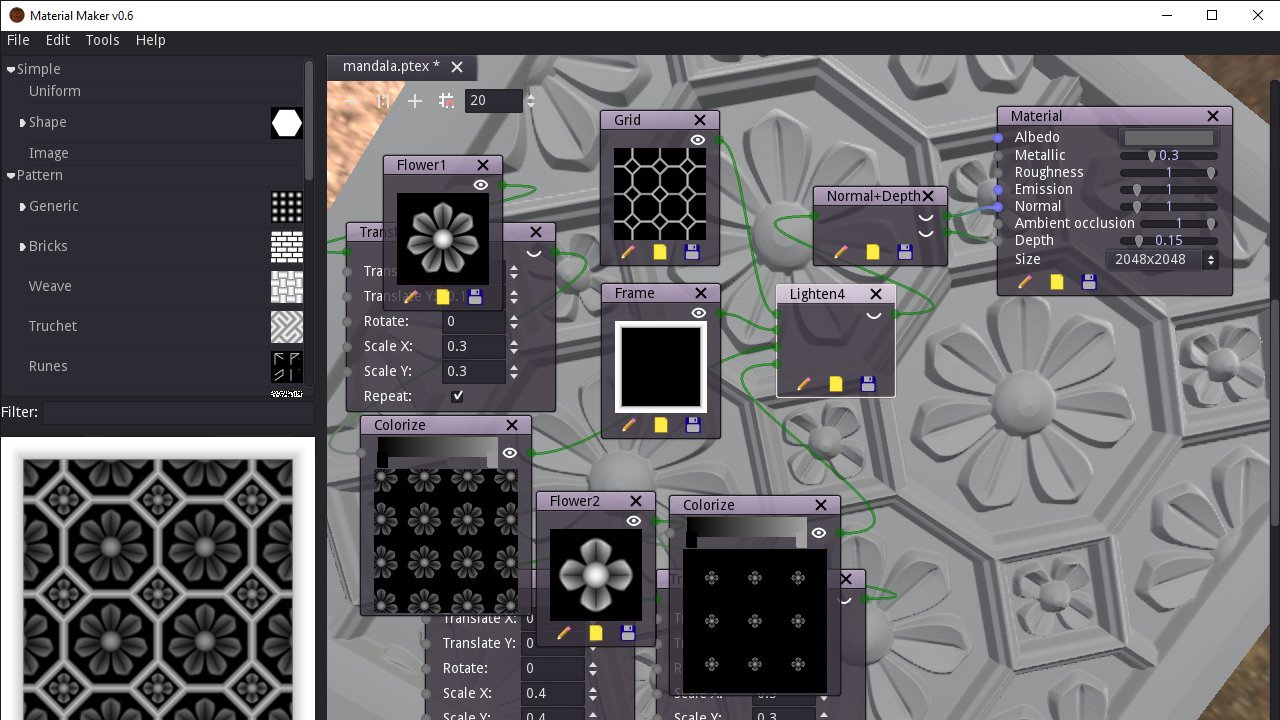
By wiring together readymade nodes, Material Maker users can quickly build up complex procedural textures.
The nodes themselves are divided into similar categories to Substance Designer, including Generator nodes for creating base patterns, and Filter nodes, for modifying the base pattern into a usable texture. The tool set is still fairly small: in the current release, there are around 20 nodes, compared to the hundreds available in Substance Designer, but it is still possible to create quite complex textures, like the mandala pattern shown in the image above.
Once you have created a procedural material, you can export it as a set of PBR texture maps following the metallic/roughness convention used in Unreal Engine and many other DCC tools.
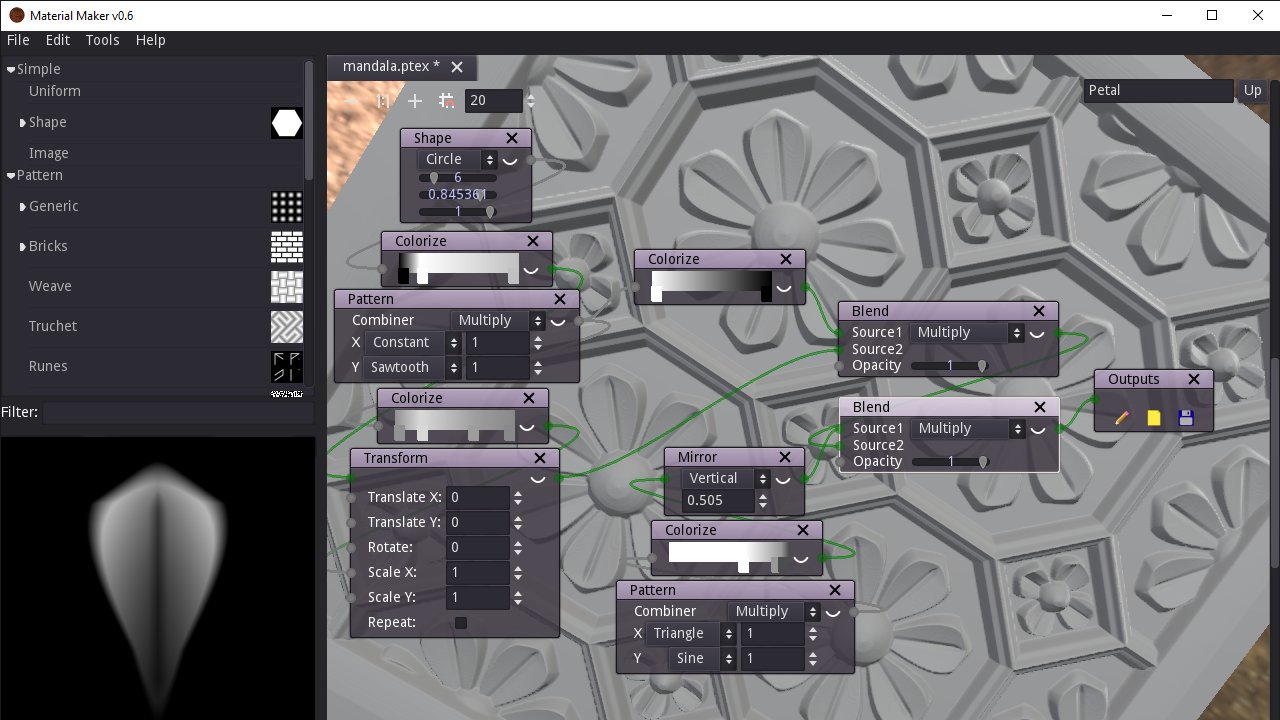
Material Maker 0.6 adds the option to collapse sets of nodes into one to keep the graph organized.
New features in Material Maker 0.6
As well as the embedded image previews within each node, Material Maker 0.6 adds a couple of other important new features. The first is the option to select sets of nodes and collapse them into a single group node, helping to keep the node graph organized when working on complex materials.
The second is GLSL: the update makes “nearly all” of the software’s generator nodes GLSL shaders. As well as improving performance, that makes it possible to customize their functionality by editing the shader itself, although at the minute, you will probably need to use shader code you have tested in an online editor like Shadertoy, as Material Maker has no native diagnostic tools.
System requirements
Material Maker 0.6 is available for Windows and Linux under an MIT licence, both as a standalone tool, and an add-on for the Godot engine itself.

I have been waiting for such a tool for a long time. I also like to use this here. it’s very fast.
https://www.kchapelier.com/graph.ical/
This does not appear to load any content.
press the spacebar or better rtfm : https://github.com/kchapelier/procjam2018
don’t forget the very useful size trick https://github.com/kchapelier/procjam2018/wiki/Changelogs#122-2019-01-19 :-)
Thanks. What I meant was not loading is the actual site that the link above is for.
Very nice!
In Linux version 0.6 you need to change the permission to execute the binary.
This will be great if it does become a viable replacement for Substance!
Does it support creating layers that you can drag and drop to rearrange the order of? Because that’s pretty much the only thing that Blender doesn’t support for it’s material system and the only thing I’d want from a dedicated material editor.
Wow… at last!
I’ve both Painter and Designer but frankly after adobe buy them I was thinking for a long time to drop them and change it for open source stuff. This will be an amazing Christmas for me this Year ;)
Many Thanks to the Developers. I’ll will support You Guys!
There is armorpaint that is good for replacing substance painter I think