

Blender in Science: Parametric Anatomical Modeling

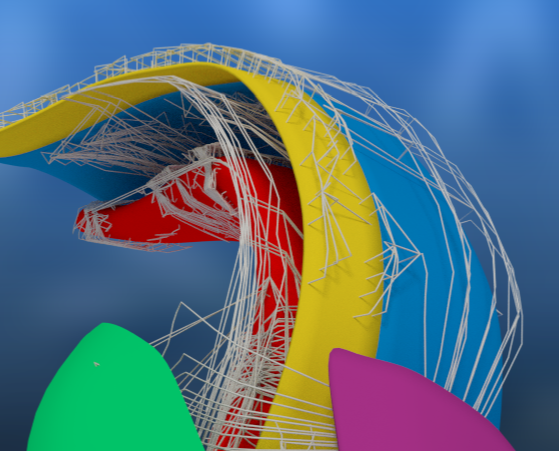
Martin Pyka uses Blender in neuroscience research to visualize brain structures. A Blender add-on transforms his raw anatomical data into layers that can then be easily manipulated and displayed.
I work as a computational neuroscientist at the Ruhr-University of Bochum, Germany, and Blender has become an important tool for our research. We study the hippocampus in rats, a structure in the brain that is important for spatial navigation and the formation of episodic memories. The wiring of this structure is very complex and hard to model when you are only left with a programming language.
Therefore, I recently developed a technique, called Parametric Anatomical Modeling (PAM), that let us translate anatomical data into a formal description of neural networks. PAM is implemented as a Blender-plugin and can be downloaded here.
For a quick introduction into this method I created a video:
In our scientific paper about this method, I devoted a small chapter to the benefits of implementing PAM on top of a 3d-modeling software and Blender in particular.
In general, I think the fact that one can easily build user-interfaces within Blender makes it very interesting for developing specialized software and rapid prototyping in some scientific domains.
Best,
Martin




Science and blender together!!
D:
It’s really amazing where you find blender and creative minds meeting together.