
Review: ‘Blender et POV-Ray’

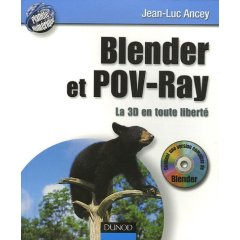 A few months ago, I spotted a French book called ‘Blender et POV-Ray – La 3D en toute liberté’ on Amazon.com. After looking around in the French community I found Michaël Thelliez who was prepared to check the book out for us, so I ordered him a copy. Here’s his report.
Author: Jean-Luc Ancey
Language: French
The provided CD contains Blender 2.37, numerous Python scripts allowing to automate 3D tasks and to link together Blender and Pov-Ray.
After a long introduction in which he explains his choice about these two freewares, the author details their installation on the most common three platforms: Windows, MacOs and Linux. Then, before diving into the main’s subject, some background about 3D computer graphics is provided, mainly focusing on 3D meshed objects.
In the chapter 4, the author details the SGML format (both for 2D and 3D subjects). This format is, according to Jean-Luc Ancey, suitable for a usage between multiple softwares, even if it is not a standard format, as long as the user can satisfy himself with working with mesh objects. This is why the author limits his study to the mesh objects and even manages to convince us that it is fully enough.
Chapters 5,6 and 7 are dedicated to the handling of Blender. The users already familiar to this software should learn nothing new, but those who are not could, thanks to the clear, detailed and abundantly illustrated explanations, learn the basis of this marvellous software.

The chapter that deals with the modeling of the shapes is very well illustrated.
It’s only at the end of the chapter 8 that the reader learns how to export a file towards Pov-Ray and to do his first render. A big part of this chapter is dedicated to working with command lines, mandatory to the use of the set of python converters provided by the author.
The end of the book is about the analysis and understanding of the structure of a regular Pov-Ray file, the automation of 3D tasks using Python and a short introduction to animation, but without much details because this last topic is not his main field of interest.

All this showroom was made in a procedural way from the series of computerized photos which decorate walls.
The explanations are always clear and detailed but the last chapters will require a lot of involvement from the beginners.
The book is abundantly illustrated (especially the chapter dedicated to Blender wich includes numerous screenshots) but some attractive examples of POV-Ray pictures are desperately lacking from the book, and the reader don’t really feel urged to use this renderer; on a personal basis, I had to visit Pov-Ray’s website in order to see some outstanding works and understand the marvels it allows). In spite of an excellent work, the author did not manage to convince me to use Pov-Ray for the moment. The images that Pov-ray could render are outstanding but would really be difficult to achieve without a user friendly GUI. According to Jean-Luc, the use of command lines associated to a perfect knowledge of the SGML format are a big pre-requisite to the achievement of top quality images. Without much skills in these fields,I’m willing to believe him, but I’d rather rely on Yafray for its ease of use.
As a final point, it’s not a surprise to say that this book is not intended to english speakers. The author is a journalist and uses typically French expressions and neologisms. You will really have to be knowledgeable in Molière’s tongue in order to enjoy this book !
- Blender et POV-Ray la 3D en toute liberté
 on Amazon.fr
 on Amazon.fr

If only i listened more in French lessons instead of talking to my friends the whole lesosn
Yes, I came across this book in the Fnac in Brussels some months ago. I leafed through it but found it a bit lacking in the Blender-Pov connection (Blen2Pov was already out then so I didn’t really see the point in buyin this book)
As stated, it did look like it had a nice intro into Blender (but Olivier Saraja’s book blows it away in that aspect so that’s the one I bought some weeks later…. )
Same feeling here, ordered it as soon as it popped up on amazon…
I was expecting too much from this book overview and returned it for a refund after a couple days.
It maybe good for highlighting blender’s potential to a cg hobbyist.
But the conversational style and approach did not feed my need for solid information on getting effective within Blender itself.
In this respect, I recommend Olivier Saraja’s book too !
And to learn english to support/enjoy the community effort on documentation.
It happened. Travelled two weeks in France, as always in spring France is beautifull. Spend a a day or two in a city and hang out in book shops, not for informatica books. They re-invent new words in informatica, translations and this make reading “informatique” books not easy for none native readers.
My eye catches the book and it seems to be something different. Every evening I was reading the book it catch me. A different way of reading: not a blender nor povray book indeed, but a reflection of the author view on 3D programs the formats of the files and proposing one and his idea about it.
To be short: the book has good ideas, explanation is clear, gives a lot of ideas and insight in 3D, but not a learning book for Blender.
I’m still reading it, for the 2 ° time, slower than …, a verry own style and giving a lot of thinking…