

E-Cycles 2020 is coming, 50% off to celebrate!


E-Cycles 2020 is coming! Sales extended to 4th of January.
E-Cycles was improved a lot in 2019. The 2020 version will have all this improvements plus a complete rewrite of my code for even faster rendering. The first test build of E-Cycles RTX 2020 is now available and first tests show up to 4x faster rendering out-of-the-box.

Figure 1: Render by JLE Studios – New Zealand and made with E-Cycles. Original Tweet.
You can get E-Cycles with 50% off until the 28th of December with the code „holidays“.
E-Cycles 2.82 builds with Mantaflow, UDIM, USD export, random UVs per island, Light Groups and much more are already available!
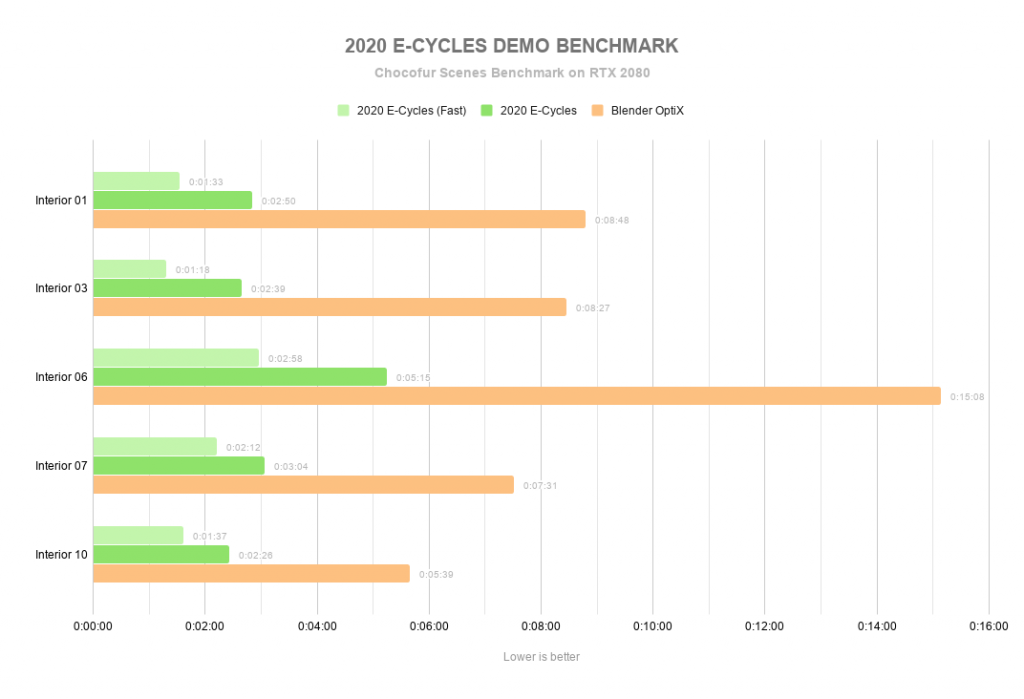
Figure 2: Render Time comparison by user Hyesung using E-Cycles RTX 2020
New features and improvements since the first E-Cycles release:
Planned were 12 improvements for 2019, as of now, 30 were made. On top of the weekly builds, here is the changelog since January until now:
February update
- up to 5% faster rendering in some scenes.
- new Dithered Sobol sampler for cleaner render at low samples (original Patch by Lukas Stockner).
March Update:
- Cleaner Viewport renders in complex scenes.
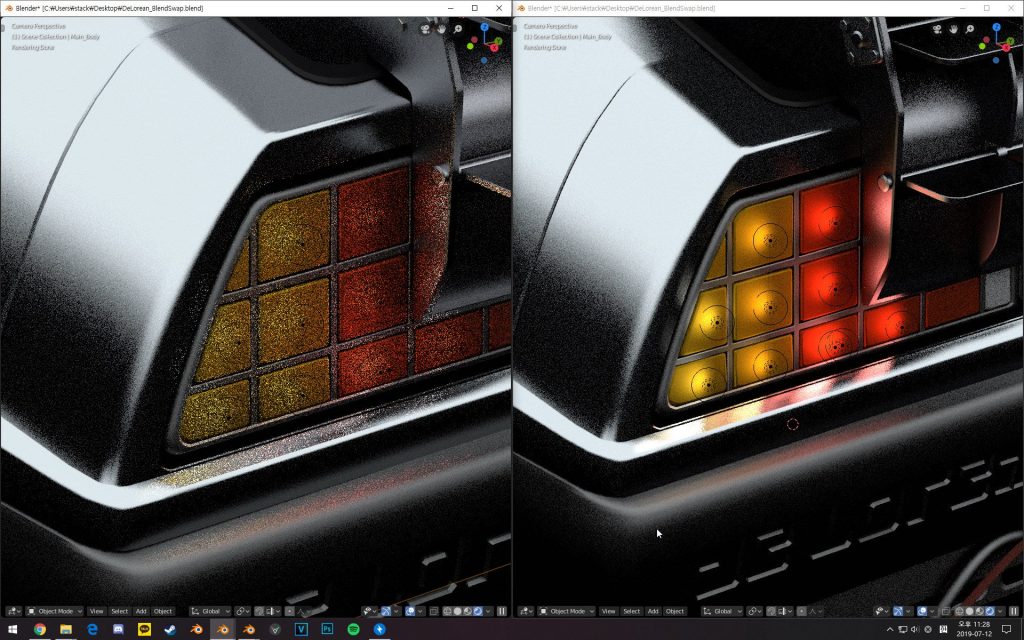
Figure 3: Viewport comparison by user Stak between Blender on the left and E-Cycles on the right. Original Tweet.
April Update:
- Intel Open Image Denoise Patch from Stefan Werner is included.
- Latest Filmic log encoding for top-notch post-pro as recommended by Bartek Skorupa https://www.youtube.com/watch?v=kVKnhJN-BrQ.
- New option based on the scrambling distance patch from Lukas Stockner, allows to render up to 40% faster (on top of existing speedup).
- Uses half the memory when denoising with all passes (transmission and SSS included).
- New AI denoiser addon which can now generate denoising node trees in one click, even in complex scenarios and with very high quality.
https://s3.amazonaws.com/markets-rails/uploads%2F1569610888357-16spp+comparison.gif
Figure 4: Comparison at 16 sample per pixel of the “denoise” node in Blender (long manual node setup with recommended settings, still blurry) and the AI denoiser default results in E-Cycles (added in one click).
May Update:
- E-Cycles 2.8x got 2 improvements ported from the 2.79x branch. Memory usage is reduced in most scenes, allowing to fit bigger scenes in the GPU memory. Rendering is also around 10% faster compared to the April update.
- Both the 2.8x and 2.79x versions can render up to 2x faster when using the old denoiser (the one from Blender) on multi-GPU setups.
- Updated to latest Open Image Denoise, using 38% less memory to denoise.
June Update:
- E-Cycles will automatically choose memory efficient code path depending on the scene, using up to 40% less memory than master/buildbots (BMW scene on a 2080Ti goes from 2GB on buildbots to 1.2GB memory usage in E-Cycles).
- An option to force one memory efficient option has also been added. It makes transparent shadows optional. Render times can be greatly reduced in some scenes.
July Update:
- The AI denoiser tree generation has been improved and has a better auto layout now.
- Adaptive sampling is now available for CUDA and can bring some good speedup in selected scenarios. Own test on smoke+fire shows up to 2.5x faster rendering compared to the June update. (Although only CUDA is officially supported, OpenCL users also report noticeable speed-up)
August Update:
- Based on the official 2.80 version.
- AI denoiser updated to 1.0. It allows to denoise renders of any size with low memory usage.
- New buttons for quick background command line render. You can then close the UI, which gives better stability, makes more memory available for your scene and also speed-up render in many case.
- Baking render speed was optimised in some scenarios.
September update:
- Completely reworked AI denoiser:
- faster, particularly on multi-GPU setups
- much better memory management thanks to a patch by Stefan Werner
- streamlined denoiser UI
- automatic optimizations of the denoising tree. Improves denoising and rendering speed.
- Faster baking:
- Baking is now up to 20x faster by taking smart decision for optimal performance.
- Baking will require a bit less memory too.
October update:
- Added a remove double modifier.
- Added an experimental bridge modifier.
- Added bevel and crease weight to the boolean modifier for non-destructive and easy to use bevel after boolean.
- Nebulae Build as an example of targeted optimizations potential.
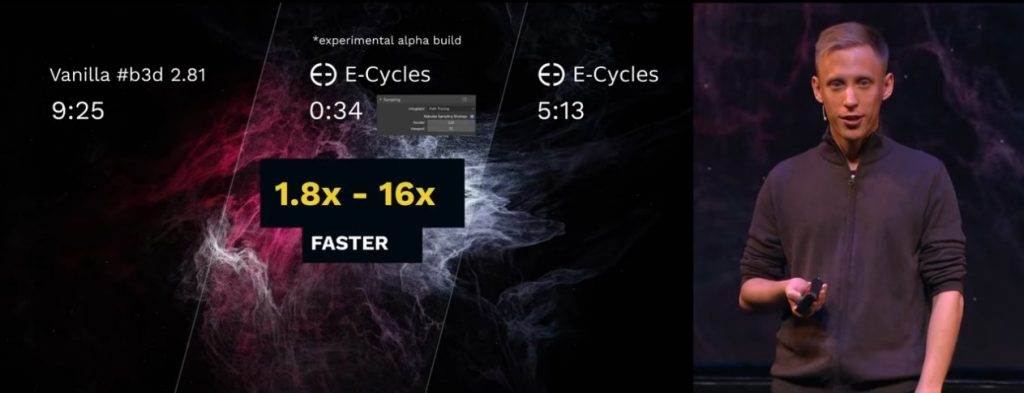
Figure 5: Presentation during Gleb Alexandrov’s talk at the Blender Conference 2019
November update:
- out of core Rendering for RTX (speed limited by system Ram, may require Quadros or Teslas for good performance)
- much faster rendering for RTX
- further optimizations for CUDA.
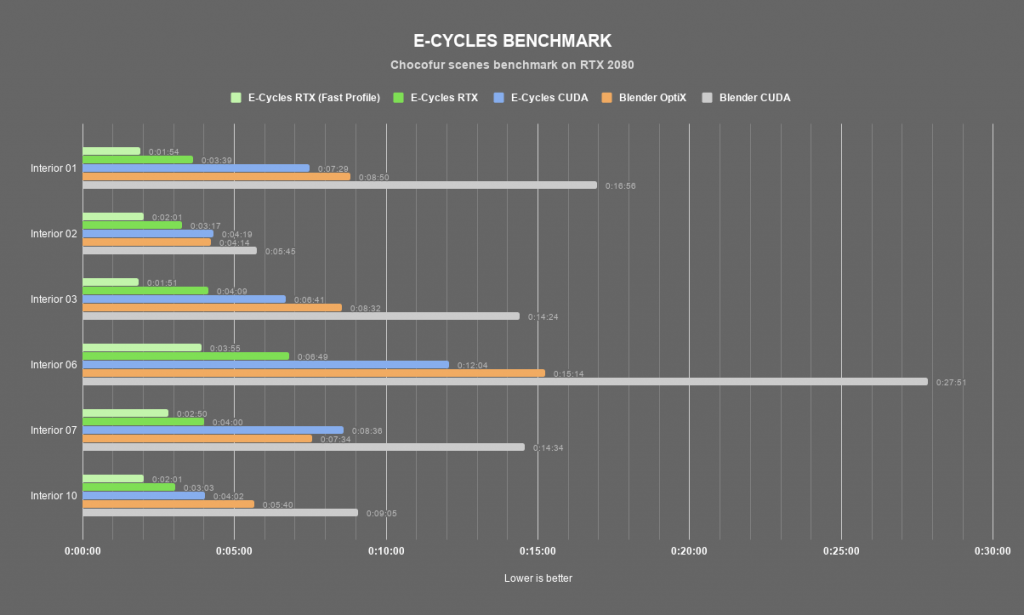
Figure 6: Render Time comparison by user Hyesung using E-Cycles 2019 november update. Original tweet.
December update:
- faster pre-processing in some scenes
- light groups patch added.

Figure7: Render of Sintel made by Ed O’Conell with E-Cycles and Grasswald. Memory optimisations allow to use higher subdivision levels and more particles. The AI denoiser allows to use low samples count even with strong bokeh.
You can get all those improvements plus the upcoming one including AI technologies I’m working on with 50% off this week using the code “holidays” during checkout.

Best purchase you can do for blender !
ever !
i highly advise everyone to give e-cycles a try !
So the developer doubles the price of the RTX version then gives a 50% “discount”???!
no no it’s a brand new E-cycles, not the same as the old one :)
Last week I looked at buying this. It was several hundreds $ cheaper.
Geeeee… When I saw the price my eyes popped out :(
it’s the price of any good render engine ? look at vray price ? octane ? redshift.
i don’t get it. this is not a simple addon, it’s a super fast rendering engine, faster that redshift even..
Hi,
I guess you speak about the pack for 2019+2020? I think you are mixing it with 2020 alone, which you can still get here https://gumroad.com/l/yeaFq/preorder .
I also had a reduction last week on the 2019+2020 pack as 2020 was a pre-order and I had difficulties in private life which resulted in slower support. I compensated it with a lower price. It was $399 then, so a doubling would be $798 so I’m not sure you meant that? Anyway, you can get 2019+2020 for about $275 now. Knowing it transforms any RTX GPU in 2, I think it’s a more than fair price for 2 years versions?
I think there is a general fear in the Blender Community that someone will go gready and become Autodesk. It’s a) not possible because of GPL, I even offer a course teaching how to do E-Cycles yourself to make it even more possible for anyone to continue my work. b) there is a reason why V-Ray still has no plugin for Blender and other like Redshift promise it for years without anything real. The 3DS, Cinema4D and even Sketchup community are much better for people interested by money. So please, be critical, but try to be fair with me. If you don’t trust me, look at all my ratings on both Gumroad and Blender Market.
Kind regards,
Mathieu
Hi, Mathieu –
Thank you for your comments. I think this situation is made more confusing by the different releases you have made available. On GumRoad I can pre-order E-Cycles 2020 for 199 Euros. However on Blender Market I can order the 2019/2020 version for 549 USD – which is double the price. If I use the discount it could 275 USD – but it is still more expensive than the GumRoad version.
The problem is you do not say when the 2020 version will become available. In 5 days we will be in 2020. Will it be available on January 1st?
Ultimately you are asking a lot of money for this addon so you need to be very clear with your customers.
Hi Antar,
the 2020 version will start to get weekly update next week indeed. I tried to remove the 2019 version from sales in November already, but I got instantly people asking for it. Many professionals want a stable version to work with. And looking at current sales, it looks like a lot of people prefer stability with 2x faster rendering over the 4x speed-up.
2020 will be based on Blender 2.82 at the begining. 2.82 has currently over 2000 bugs opened, so I can understand their need of a 2.81a version, thus the 2019 version still being present. And for those prefering features over stability, I offer the Gumroad link with only the 2020 version.
Kind regards,
Mathieu
Not the point. It was cheaper last week – now it’s much more expensive AND it’s coupled with a discount. In other words, it’s not really a discount at all.
PS. For the record i already own Vray for 3ds Max. E-cycles is a Blender add-on. Blender is open source. It’s different.
No. Octane, vray and soon redshift FOR BLENDER are sold for this price…
And again, it’s not the same product.
It is the same product. I repeat I have been watching it closely for a very long time. Had the developer offered the discount without increasing the price then I would have bought it.
To offer a discount at the same time as increasing the price is in – my opinion – a little distasteful.
For those looking for 2020 only: https://gumroad.com/l/yeaFq/preorder
99 bucks is like for free!. Extend that hollyday price to 02.01.2020! pleace!
Sales are extended to the 4th of January!
Wow this plugin cost more than a RTX card, I hope that Cycles programmers can improve the code in 2020 and the Blender community can take advantage of major GPU models in the market.
You are also welcome to show me a PC configuration with vanilla Blender that would match the render speed of an RTX 2070 super plus E-Cycles RTX 2020 in any scene in the first chart of the article. If it’s cheaper than the solution with E-Cycles RTX, you get E-Cycles RTX 2020 for free :)
Can you point to an RTX card for less than 199€ (https://gumroad.com/l/yeaFq/preorder)? The price you speak about is for a bundle of 2 versions. And even if it was true and E-Cycles RTX was more expensive than an RTX card, the 2020 demo shows a mean of 3x faster rendering, so it’s worth 2 additional RTX cards. Asking for the price of one would just be a fair 50/50 between developer and user.
You are also welcome to show me a PC configuration with vanilla Blender that would match the render speed of an RTX 2070 super plus E-Cycles RTX 2020 in any scene in the first chart of the article. If it’s cheaper than the solution with E-Cycles RTX, you get E-Cycles RTX 2020 for free :)
Assuming such a thing is possible, are there any render farms utilizing it, and would a user have to purchase the add-in just to instruct the render farm to utilize the add-in?
Assuming if such a thing is presently impossible, are there plans to rectify that?
Treat the following as coming from a completely ignorant (but well-intentioned) potential customer.
Suggestions:
1. Provide a feature/limitation comparison chart.
E-Cycles 2019… E-Cycles 2019 RTX… E-Cycles 2020… E-Cycles 2020 RTX… Works with Blender 2.80 check check X X… Works with Blender 2.81 check check X X… works with blender 2.82 x x check check… works with cuda… check check check check… works with rtx… x check x check… etc.
2. Offer upgrade (sidegrade?) options. I can rationalize spending 100 (or 50, on sale). Not sure I can rationalize spending 550 (or 275). Maybe in the future I can rationalize spending 450 (or 225) to make up the difference. If that feature is missing, I’m much less likely to offer 100 (or 50) now.
Hello,
I’ll make announcements about Render Farm availability when ready. It’s indeed being worked on.
1. thanks for the feedback, I’ll add a comparison chart.
2. I offer both upgrade and sidegrade already. Sidegrade are simple: I deduce what was already paid, so you only pay the difference. Upgrades from 2019 to 2020 for existing users are at 49€ for standard (= 4€/month) and 149€ for RTX (= 12€/month).
Alright then. Take my money.
It took a bit of time, but I made a section “which version is best for me?” on the product page. I tried many variants and kept it short, I found it better than a table. If you still have questions/feedback about it, it’s welcome.
Sales are extended to the 4th of January by the way!
Hello,
I’ll make announcements about Render Farm availability when ready. It’s indeed being worked on.
1. thanks for the feedback, I’ll add a comparison chart.
2. I offer both upgrade and sidegrade already. Sidegrade are simple: I deduce what was already paid, so you only pay the difference. Upgrades from 2019 to 2020 for existing users are at 49€ for standard (= 4€/month) and 149€ for RTX (= 12€/month).
So the non RTX 2020 E-Cycles is going to be $400 after the sale? Not complaining, just clarifying. :)
Sales are on the Blender Market only. The Gumroad price is with the pre-order reduction. Bas price of the RTX version is and will stay 299€.
After many request, sales are extended to the 4th of January.
Sales are extended to the 4th of January and the reduction is already applied now!