
Blender in top 10 of television PSA competition

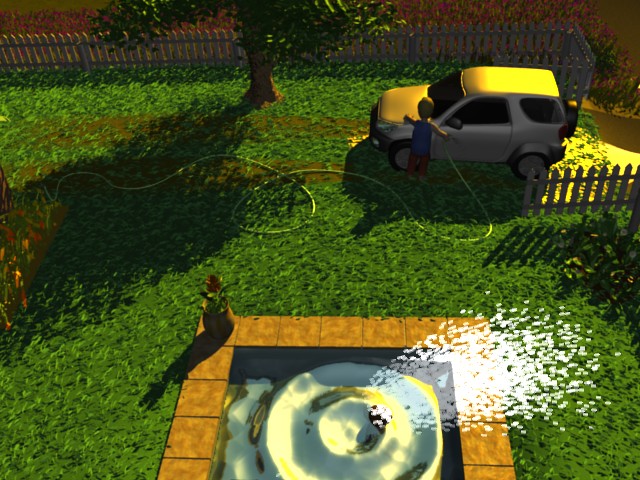 Article submitted by Allan Liddle: Blender was used to compete in the VUKA! awards in South Africa – a national television Public Service Announcement (PSA) competition, where it had to compete against video and film, as well as commercial 3D animation software – and it made the top 10 finals! What makes this more unique was that it was the only submission done completely in open source and was the first-ever animation project by a guy who had just resigned as an engineer to fulfil his passion: 3D open source animation.
- for the benefit of the community
- submitted at no cost
- on behalf of any NGO or non-profit organisation
- 30 sec, 45sec or 60 sec long
In return the organisers, MultiChoice (a pay TV company in Southern Africa), will air the best submissions for free for a full year on selected television channels. Reception of these channels are available throughout sub-Saharan Africa, e.g. South Africa, Botswana, Namibia, Lesotho, Swaziland, Mozambique, Zambia, Zimbabwe, etc.
Allan Liddle (AnyMation on BlenderArtists.org), who has sold the odd painting before (done in spare time), resigned as electronics engineer in August to fulfil his life passion by combining his artistic and analytical skills to start a new career in open source 3D animation. Even though the company wanted to retain him for longer, he decided against that, as he needed to do something to enter the market – and VUKA! was one of the best ways to do it in the short term.
Allan says:
Up to that point, I had only been able to train myself up on Blender after hours, as my job pressures did not allow for more. I got to the point where I had to decide to either make my passion and dream come true – or laugh off the whole idea.
After resigning, I set myself up with a Pentium Dual Core 3.6GHz PC, took some time to come up with a decent idea and script – and started working on my first-ever complete animation project. I tackled quite an ambitious project – with quite large scenery and many objects – and started running out of time (I’ll not easily tackle such a large scene again!). Fortunately, the deadline was postponed by two weeks – and I pulled in my son, who was a first year art student and also wants to do 3D animation, and who has also only been getting up to speed with Blender after hours so far.
 The whole project was done in open source:
- 3D animation and compositing: Blender
- 2D: The GIMP (flag texture and logos)
- Sound editing: Audacity (The music – done by talented people in Allan’s church – was recorded at a studio, but some of the sound effects were recorded on small microphones using a laptop)
- Jahshaka was used to compose the rendered files and audio files into MPG format for the electronic web version.
Only the playing out of the digital files to video tape was done on professional equipment and software.
After submission, Allan was later informed that his “Save water†animation had reached the semi-finals (1 of about 30 from the original 150 submissions). At the final awards ceremony, the same prizes were awarded in two categories: Professional and Newcomer. Prizes ranged from best concept to best sound track, best animation, etc. “Save water†managed to get through to the finals of the Newcomers, i.e. the top 10, but was not able to win a prize.
Allan reckons that
If one takes into account that all the newcomers have 3 years of training at some video or animation school, I ascribes the “Save water†animation not winning a prize to a bit of inexperience, since I only had 6 weeks of practice, but I feel very satisfied with the result. Some animation school submission did not even make the semi-finals.
If it was not for Blender’s fast development pipeline, good on-line documentation and tutorials (even if you have to search around a bit) and the friendly help of the Blender community – and of course, my son – I would not have been able to pull this off.
I am especially very satisfied with Blender’s performance in the competition as it is the first time that an open source PSA has been submitted. I have been interviewed by local newspapers and made quite a fuss about Blender and open source software and hope that it will receive a lot of publicity. What is also very encouraging is that it does not have to cost a lot to compete with the best out there. Apart from my time and equipment, the total cost was about R1500 (just over $200), for the studio costs.
The “Save water†animation is available as low resolution (+-18MB) or higher resolution (+-36MB). Be aware that you may need a relatively good graphics card, as the rendered information rate is quite high.
Allan is contemplating tackling a 3 minute short (a new category) for next year’s VUKA!

wow COOL!
Nice work! Congrats!
Very good animation and scenario.
Congratulations !
Way to go Allan. A (now) well known person in India was a successful doctor before he left that to become a successful singer, just because of his love for singing. You too go on with ur dreams.
BTW bart you have spelled him as Alan at the starting sentence and as Allan in rest of the places, so I guess he is Allan.
@AppleGrew: indeed! Thanks.
Congratulations!
Nice work. The idea is very good, the meaning is clear.
Very Nice and Congratulations!
Awsome! Really nicely done, i’m truly impressed. Honestly, these are the areas that animation should be used to a larger extent. It only follows to use open source free software for community spirited projects.
-Chris
Good job!!
Very good idea for that presentation. Maybe it´s good for Opensource, but the message its much more
important. Water is a rar and limited resource for millions of peoples around the world and we are
using it still like a “onetimeuse” resource.
A promising start to Allan’s 3D career. Especially since he’s a relative beginner.
Given a bit more time and a bit more practice, he’ll be one to watch.
Good job Allan! I too made a 60-second commercial, so I know the effort you put in, and yes, your results are excellent, visually and thematically. You really modelled a lot of terrain in such a short time – very fast, you are. And you communicated your idea non-verbally, which is also excellent and makes your commercial very universal. You should also know that here also in the USA water is a big issue, here in Atlanta and especially out west like in Las Vegas; so keep all your source files, and you may get some work from Nevada (just change the opening flag and you’re good to go!) Thanks for using Blender!!!!
Thanks a lot for the positive feedback and encouragement. All I have to do now is to start earning some income ;-)
Allan
Awesome! This is very encouraging. I’m also an ex-software engineer who quit his job to pursue a career in animation. The company I was working for was very keen on patenting software, so I had to leave. I’ve always been interested in animation so it seemed like a logical step to take.
Since leaving my old job I’ve done a 3-month course on 3D animation. I’m just starting an animation project of my own, which will also use only open-source software. I’ve almost got a script :) I’ll post more about it later, when I’ve got something to show.
Cheers!
Alex