
A Pawn in a Hurry
The Result
To finish your animation, set up some lights and set up your camera. Since your camera is just another object like the pawn, you can animate it, too. Try making it rotate slightly from left to right (insert rotation keyframes only). A few degrees is already enough to make your final animation a lot more dynamic.
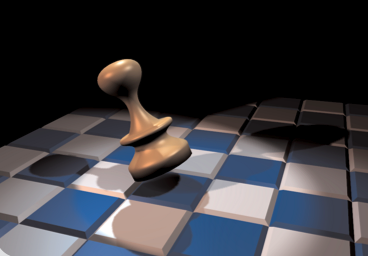
To render a single frame of your animation, go to the desired frame and press [F12] or click the ‘Render’ button.
Usually you will want to render an entire animation to disk, either as a series of images or as an AVI file. To set this up, first enter a filename in the filename box. For a series of images (not for AVI files), this name will become the base prefix of the filesnames. For example, entering ‘/render/pawn’ will result in a series of images called ‘pawn0001, pawn0002, …’ stored in the directory /render.
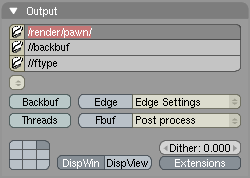
Set the correct file format. Selecting ‘AVI raw’ or ‘AVI jpg’ here will cause Blender to store your animations not as single images, but as an AVI file. AVI jpg is the most compact way of storing your anima- tions, but it comes with a slight quality loss. Change the ‘Sta’ (Start) and ‘End’ values to match your animation. For the current animation, values of 0 and 31 should be entered.
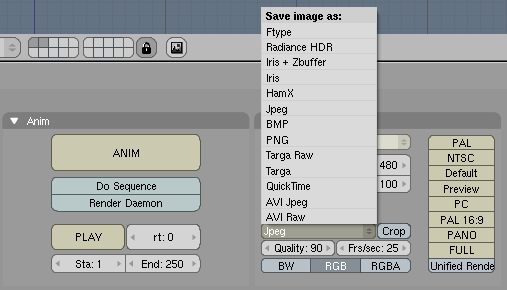
Press the ‘Anim’ button to render the entire animation.
Play it back from within blender by pressing ‘PLAY’. This opens a new window – press [ESC] to stop playing.
A Little Extra
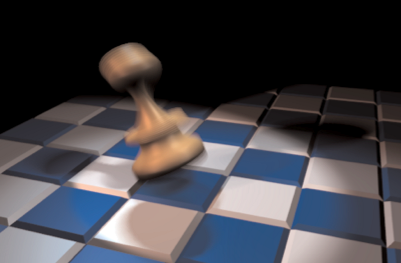
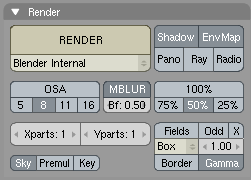
There is an extra rendering option called ‘Motion Blur’. Motion Blur simulates the effect of a shutter time – fast moving objects will become a bit blurred. Motion blur takes a lot of time to calculate, but in some cases it really adds to the realism of your scene.
Before rendering, select the button ‘MBLUR’. Leave the ‘Bf’ (Blur Factor) on 1.0; this value represents the shutter time. Ahigher value corresponds to a longer shutter time.
Here is the result of the same image as before, but now motion blurred.