
Interview with Allan Liddle

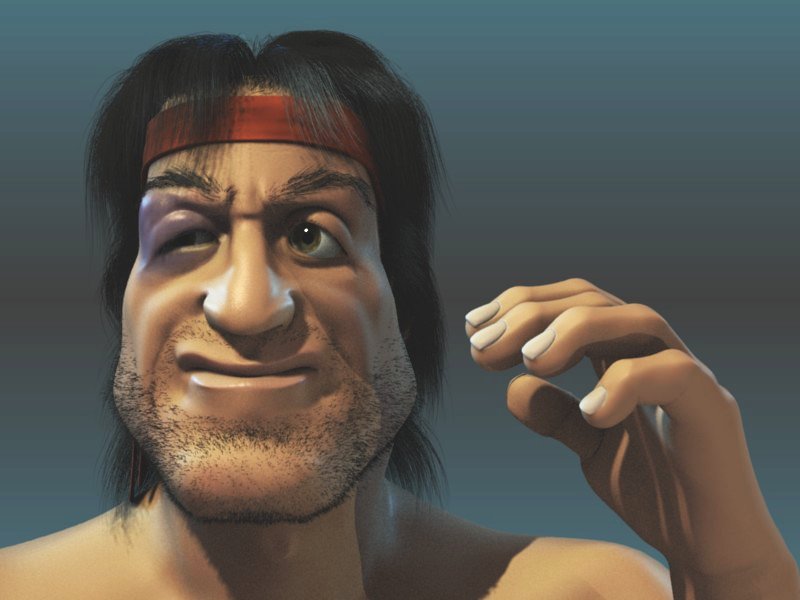 Recently, I had one of those pleasant accidental finds while I was doing a search on the Internet looking for a solution to to a Blender animation issue I had. You know how it is, you start with a BlenderArtisit.org or Google search, click on the appropriate link, then while at that linked page you see something else, not related to what you want, and suddenly, after several more cliqued links, quite some time has passed. Sometimes you get a nice find, such as this animation based on the movie character Rocky.
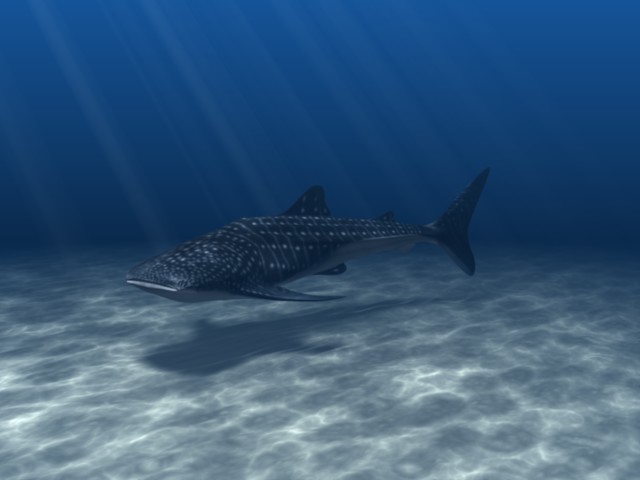
What caught my interest about this piece, besides being made in Blender, was the animation style. It’s look and feel is somewhat cartoony but yet a hint of realism in the modeling and animation, in addition to the good use of camera angles and subdued lighting, and it was funny. This piece and others are the creation of Allan Liddle of South Africa. Make sure you check out his web site, he also has excellent tutorials there as well as conducting some Blender classes. Here are the links to a couple of his animations; The Revenge (Rocky), Whale Shark
I was a bit curious of Allan’s background, so I asked him a few questions:
What is you current profession?
I currently do animation, modeling and Blender training full-time, whatever puts “bread-on-the-table-while-using-Blender”, even architectural visualizations. However, I came from a completely different environment: I am actually a qualified Electronics Engineer, who moved into software development management over the years. I am also an artist, and have sold a few painting in the past – with my favorite topics being Africa wildlife and portraits, as I find them to be the most challenging art form from a realism point of view: you either recognize a person in a painting or not.
How did you discover Blender?
Whenever I was only doing engineering work, I always missed being more creative, and when I painted, I always missed analytical challenges. As long as I can remember, I always wanted to become involved in 3D animation to combine my analytical and creative halves – it feels as if I am not running on all my pistons if I don’t utilize both these areas simultaneously. It’s difficult to describe. I even owned and played on an Amiga computer years ago. I never found hand-drawn cell animation, nor 2D animation, particularly interesting, as they seem too boring and repetitive.
When animation moved from the main frame domain to the PC, it became more accessible for me, so I started playing around with demo versions of commercial software. That was when I was introduced to Blender by one of my co-workers, also and Engineer. Initially I also thought “free and open source software cannot compare with commercial software”, but I decided to give it a go. Boy, was I SURPRISED! That was more than 2 years ago. the best decision I ever made was to buy myself the Blender 2.3 manual and work systematically working through it – even though I itched to just skip ahead. That laid a very good foundation. I can only recommend that to any beginner: buy yourself a decent beginner’s book (there are more on the market nowadays) and work through it.
Then Blender just took over: I could not teach myself everything about Blender before the next version was out, and the next, and the next… and it still continues. I now know probably around 95% of Blender and just delve into the other 5% as and when I need to.
I trained myself in Blender after-hours – not for weeks, but for months! I eventually got to the point where – due to normal engineering work pressure – I found I forgot a new Blender fact for every new one I learnt – and had to decide whether I continue doing this after hours or make the big jump to full-time 3D animation… I took the jump, and here I am!
The first ever project I did after that jump, was to set myself a high target to fast track my skilling up: our local “VUKA! Awards”. These awards are for the best Public Service Announcements (PSA) on a particular local TV channel. VUKA! is open for any medium (e.g. video). I was the first one to ever submit an open source animation. Although I did not win, I did get to the Top 10 Finalists, which I felt quite proud about. That was featured on Blender (www.blendernation.com/2006/12/10/
How did you come up with the idea of the rocky animation?
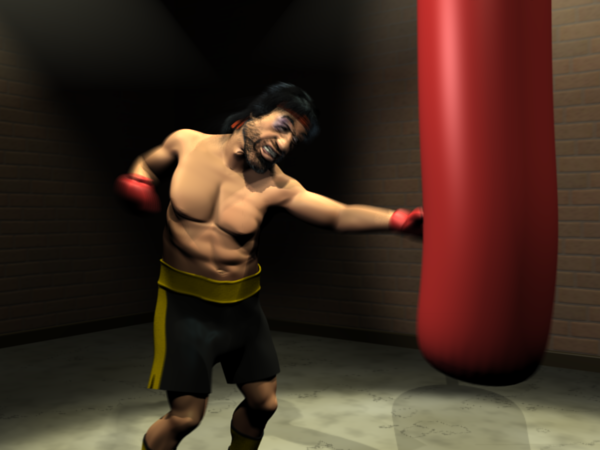
I wanted to prove to myself that I can do character animation, together with the challenge of lip syncing and music. That’s when I decided upon Rocky. I took the more difficult route: a semi-realistic caricature of a well-known person. It not only had to be a “copy” of the person, but a stylized caricature, who was still recognisable. I actually want to still do, what I believe to be my strongest point: a “normal” cartoon caricature, as that allows one much more freedom of creativity and expression. But I have not had the time (nor the money) yet… I wouldn’t mind being sponsored by somebody to turn out a 10-minute short!
Your Rocky body movements are very fluid, how did you learn to animate? Was there any classes, tutorials etc?
I have not had any formal art or animation classes. (If I can give aspiring animators a tip here: I know there are other opinions, but if you really want to excel at animation, you have to be good at art. If you are not, there is hope: one of the quickest ways to put your artistic skill into another orbit is to get yourself Betty Edwards’ book, “Drawing on the right side of the brain”. No, I don’t get any royalties for it :-) It is just flippin’ good!)
As far as the movements in Rocky animation goes, I would say the following factors played a role:
- Knowledge of the basics of Walt Disney’s 12 animation principles, which can be found here (http://www.siggraph.org/education/materials/HyperGraph/animation/character_animation/principles/prin_trad_anim.htm), but do an Internet search for more. These are also covered in many books.
- With the 12 principles in your head, do keen observation: look at how things move in real life – and study good animations!
- Get feedback from others, e.g. the BlenderArtists forum – be open for criticism and have a learning spirit
What is your favorite thing about Blender besides being free?
Some of the strong points in my mind about Blender, are:
- Many studios use a plethora of software tools: they model in the one, animate in the other, do cloth elsewhere, sculpt somewhere, render in another and composite it who-knows-where. What makes this kind of pipeline tricky, is the fact that you continuously have to bake, import and export your work in various formats between these packages. Not only is it very time-consuming, but you end up losing flexibility once you start baking and exporting data. Also, doing fixes and changes become a nightmare, because you have to go back to some point in the pipeline.
Therefore, one of the GREATEST benefits of Blender in my mind, is the fact that it is so INTEGRATED. It is not necessarily the best at everything, but it is very good at everything it has – and it has A LOT! Blender is virtually a PIPELINE ON ITS OWN! It therefore makes life a lot easier when you do a complex animation: virtually everything is right there – inside Blender, no exporting and losing flexibility. Once you have a well thought out Blender process, you can focus more on the product than the pipeline!
- Blender’s GUI is SOOO FAST! I read about other people complaining about Blender’s GUI, which I can understand: they are not used to it. I was there, too. But once the “penny drops”, Blender really allows you to fly – compared to other software. I recently also did a 3-month course in “a popular top commercial 3D software package” (used in movies, but which shall remain nameless here :-) ) – and I found it SOOO excruciatingly SLOW! I once worked with somebody using that software – and I ran circles around him: while he was still figuring out what/how to do things, I had finished!
- Nowadays, Blender’s feature richness and maturity: Blender is nearly on par with the best out there now, especially with 2.46. Imagine what it will be like with 2.5!
- Blender’s stability: I wonder how many people realise just how stable Blender is? My experience with the other software, as well what I hear from others working in various software packages tell me that Blender is VERY stable. Compared to other packages, Blender has very few crashes. I really hope it will stay that way with Blender becoming more complex.
- Because of its nature, Blender can play a major role as an economic enabling tool. I am busy registering for my BFCT certification and setting up a Trust, but am already giving training in Blender because I believe it can open doors for talented, but underprivileged people. They may otherwise not have the financial opportunity to become involved in 3D animation, due to the very high cost usually associated with courses that involve commercial 3D software, never mind setting up a studio. With Blender, one is able to provide quality training at a lower cost (especially in our South African Rand currency) to the benefit of the students. This is especially true for a country like South Africa, where unemployment is a major factor. At the courses that I presented in Cape Town so far (the last was in conjunction with the Cape Film Commission), I sponsored some of the students, but the need is great – so any contributions are welcome! I am also scheduled to give training in Johannesburg in April and in Nigeria in May. Once I’m certified and have the Trust in place, please invite me to give more advanced Blender+animation+art training in your first world countries :-) , so I can use those Dollars, Pounds or Euros to plough into economic enablement of South Africa and Africa’s 3D animation industry – using Blender and Open Source of course!!!


Go for it Alan! This is a sterling example of Open Source making a difference!
The models and overall quality is really good!
Animation could be improved though, for example: you can’t ‘feel’ Rocky/Rambo hitting the bag; the swing of the arms could be more anticipated.
The juggling ape is well done but here is one essential problem: the animation of the flying balls. They are dropping and flying much too fast.
I’d just like to say that I got interested in Blender about 2 years ago, considered 3d/animation schools, and realized I had to learn to draw first. I’ve been practicing drawing for about 1½ years now, and have made lots of progress, especially after I read the above-mentioned “Drawing on the right side of the brain”. For anyone who wants to achieve good results, I suggest you follow Mr Liddle’s example and avoid getting too stuck up in just 3d-modeling.
Looking back, I agree with you Rattle. But that was my first-ever proper character animation. (The last one I did was a simple Humpty Dumpty egg-face to do shape key tests) There are a lot of things I would do differently now.
The one concept that slipped through in the text above (or I left it out in my reply to Tim) was the fact that I want to next do a cartoony-type animation (Pixar-style). With a cartoon character, you can use much quicker movements and push the 12 animation principles much further, including stretching, etc. I want to really get the conservation of volume and momentum under the belt, as I think that is the basis of most of those principles.
AnyMation, those are great ones, no question.
I always try to give a bit of a critique
offtopic….
anyone else notice the 2.46rc2 builds at http://download.blender.org/release/Blender2.46rc/
for every os cept windows :(
Congrats on making it on Blendernation again Allan! Awesome stuff.
Hehehe… these caricatures are awesome :)
If you google “spitting image” one might wonder :
why not use blender to make a show like this on TV one day :)
what would you suggest for somone like me, who wants to get into 3dcg. but hates everything exept blender and am constantly being told ‘if its not industry standard, its no good’?
blender is a hell of alot faster than anything else iv used
“Whenever I was only doing engineering work, I always missed being more creative, and when I painted, I always missed analytical challenges. As long as I can remember, I always wanted to become involved in 3D animation to combine my analytical and creative halves – it feels as if I am not running on all my pistons if I don’t utilize both these areas simultaneously.”
This reminds me of something I read once: “At heart, all engineers are frustrated artists.”
“(If I can give aspiring animators a tip here: I know there are other opinions, but if you really want to excel at animation, you have to be good at art. If you are not, there is hope: one of the quickest ways to put your artistic skill into another orbit is to get yourself Betty Edwards’ book, “Drawing on the right side of the brain”. No, I don’t get any royalties for it :-) It is just flippin’ good!)”
http://www.wowio.com has several ebooks that might appeal to Blender users. They’re actual PDF’s of full books like you’d find in any bookstore, and they’re free. (They have more than art books, but those are the ones most appropriate to this discussion.)
I found Wowio through the BlenderNewbies blog: http://blendernewbies.blogspot.com/2007/09/free-art-and-graphics-books-from-wowio.html
Here’s the BlenderNewbies list of titles: http://www.blendernewbies.com/misc/books/wowio/wowio_rec.html
Some sample titles:
Anatomy for the Artist http://www.wowio.com/users/product.asp?BookId=923&Link=1
Advanced Drawing Skills http://www.wowio.com/users/product.asp?BookId=922&Link=1
A Foundation Course in Drawing http://www.wowio.com/users/product.asp?BookId=817&Link=1
The Fundamentals of Figure Drawing http://www.wowio.com/users/product.asp?BookId=818&Link=1
The Fundamentals of Drawing: A Complete Professional Course for Artists http://www.wowio.com/users/product.asp?BookId=463&Link=1
MB, I appreciate the books and the links that gave here.
However, the thing I like about Betty Edward’s book, is the fact that it teaches you to SEE things differently. I’ve noticed many times that you can teach people good drawing techniques, but that only teaches them recipes. They need to start SEEing things for themselves (not what they THINK they see) – then they can really improve their drawing skills.
mb, the books you mention seem great and the links are appreciated (although one can’t download them outside the USA :-( )
However, what I find great about Betty’s book, is that it teaches one to SEE things in order to change the way you draw. I have seen many people using “standard” drawing books, but they end up following recipe – instead of really SEEing things differently (as opposed to THINKing they drawing what they are seeing) and being able to let that influence their drawing.
mb, the books you mention seem great and the links are appreciated (although one can’t download them outside the USA :-( )
However, what I find great about Betty’s book, is that it teaches one to SEE things in order to change the way you draw. I have seen many people using “standard” drawing books, but they end up following recipe – instead of really SEEing things differently (as opposed to THINKing they drawing what they are seeing) and being able to let that influence their drawing.
Let me try again (I hope the message goes through this time):
mb, the books you mention seem great and the links are appreciated (although one can’t download them outside the USA :-( )
However, what I find great about Betty’s book, is that it teaches one to SEE things in order to change the way you draw. I have seen many people using “standard” drawing books, but they end up following recipe – instead of really SEEing things differently (as opposed to THINKing they drawing what they are seeing) and being able to let that influence their drawing.
Allen & MB FYI
http://www.blendernation.com/2006/10/05/book-drawing-on-the-right-side-of-the-brain/
AnyMation, try the software “Hotspot Shield” for using it outside the US.
If the allow it only to US users they don’t need to go online. Hotspot is a software to secure your computer when using WLAN spots and wowio can’t recognize where you come from when using the shield. It’t not illegal.
Rattle, I tried it – it doesn’t seem to work, or actually, I seem to have trouble accessing the web site when using it. I’ll try again later.