

EDM Studio – Professionals Using Blender

 Recently, there have been some interesting posts on Elysiun that deal with people moving from Blender to other 3D programs. Disturbing as I was reading about this, I went looking for companies that use Blender on a professional level to show that Blender can do a professional grade job.
We use Blender extensively. The reasons are three-fold. First and foremost, Blender is a really good piece of software (an assessment based on our varied experience with a raft of other professional packages such as Houdini and 3D Studio Max). Next, Blender is open- source; this gives us access to the code internals (and the resultant ability to make changes and apply patches as needed) plus access to a vibrant and supportive online community. Finally, Blender has adopted Python as its internal scripting language, and python is our small studio’s “secret” weapon – both for rapid prototyping, production systems, and as a general-purpose software glue.
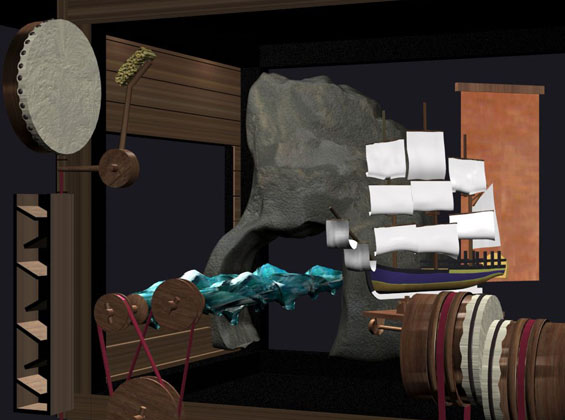
Blender played a major role in our recent Eidophusikon project, a cultural history installation that combines a miniature physical recreation of an 18th century animated diorama along with a “behind the scenes” virtual view. This latter 3D view was done completely in Blender using two virtual cameras to render perspective-correct left and right eye movies. Playback was via 2 stacked DLP projectors onto a rear projection screen using Infitec passive 3D technology (projector filters + viewer glasses). As our deadline loomed, final rendering of the combined 7600 left and right eye movies was done on a 150 node Linux cluster. Thankfully, Blender comes with ‘infinite’ render licenses (laugh).
I also spoke to Darran about green/blue screen issues following BlenderNation’s camera tracking post (http://www.blendernation.com/2006/03/29/rules-of-camera-tracking/). His comment following the suggested green screen construction link was that
A decent alternative to an actual green/blue screen is to use retroreflective material and surround your camera with a ring of LEDs. I’ve done some experiments with this and it works quite well, the advantage being that you don’t need to worry so much about lighting issues.
EDM Studio has some experience in this since they’ve actually designed a device that uses this technique. A good overview of this can be found on their site.
Seeing companies using Blender in any capacity to turn out fantastic products and services makes certain that Blender will remain an important tool and will be incorporated into more and more production pipelines.

I am a technical director of Graphite Media Studio in Ukraine and we use Blender extensively. I have 2 designers working in it and I hope I will have more of them soon. We are making some animations for one of Ukraine s most popular TV channels, so we support the notion that Blender is 100% professional thing.
I’ve been running a digital-media-creation business for some years now and I’ve been using blender as my choice for 3D since the first day. It’s become incredibly much better over the years, but even back then it allowed my to create professional work.
I’m a graphic designer/illustrator from France. I am using Blender/Yafray or Blender/Indigo for some of my professionnal projects since 2004. The Blender developers are doing an excellent work and they work fast.
Thank You for Your work!
i like a lot 3d modelling .so i d like to know if if tere are lot of job tat we can find wit tis
Blender is in my opinion comparable to other 3d applications. I am a artist, programmer working in TI sector Montreal. I’m also the owner of FLB STUDIO. I like programming python inside and outside Blender.
Here is why Blender is the best 3d application for me.
1)-OpenGL interface. verry small program with all professional features
2)-Python api
3)-Keyboard mouse fast and easy short cut.
4)-Best modeling interface and technique (verry close to wings 3d)
5)-Superb costomizeble GUI and views.
6)-Blender files can be use like linkable Library to oder blender files.
7)-Planty of many more.
You have to try it to beleve it.
With blender I always get what I want.
Blender is my top favorite 3D graphic application. I love it!
Plus I’ll like to mention that I use and test all other 3D application before, like 3Dmax and softimage, but no other application give me the feeling of being in control with ease and pleasure.
At area42 – Agentur und Systempartner we used Blender as a professional solution for realtime3d authoring and rendering. An example for this is http://www.miodrago.de/ we created the 3d images and the realtime3d visualisation ( http://www.miodrago.de/cms/index.php?id=11 ) in Blender.
Finally now made some toon renderings for the manual of it:
http://blendpolis.serverpool.org/a/miosw.png
http://blendpolis.serverpool.org/a/miodrago2.gif
This is just one example and all i can say i love working with Blender!
Good to see Blender being used where you’d usually see 3DS or Maya taking over.
We are a small VFX production company and use Blender in our production pipeline in addition to 3D Studio MAX and Digital Fusion.
The only reason why we started to use Blender was because it is for free.
In the beginning we used it as a pure modelling tool, but step by step we use more and more features of it and it plays a more and more important part.
The biggest weakness of Blender is that because of the strange user interface, it is not easy to convince talented people to learn it. I think because of that, Blender can not hold up with the commercial packages (at least at the moment) and it will take a couple of years until it can…
Thanks for the post Luminansky! Great thoughts about the usability of the interface.
Love your company website!
I’m a designer in BEE Polska, the playground manufacturer. I use Blender for every product visualization and more. Last year, we decided to go only for Blender. Now with the end of the year, I must say that this was a good choice.
We start with our website next year, also with use of Blender (the interactive 3D applets).
I must say, that the interactive presentations we made with Blender this year, completely amazed our customers!
Blender is a replacement for 3 programs for us: 3DS, Director and Premiere! Only we pay for none of them :-)
Thank you for your work!
I am a 3D artist and I enjoy Blender. It utilizes a rather robust user interface (UI), but after learning it (through the many websites with tutorials–esp. this one, a Blender wiki, and good video tutorials available), you’ll not only be more knowledgeable of the Blender UI, but of 3D modeling/animation/rendering concepts in general. It takes some work, but the anticipated results are well worth it! Just Google a Belgian guy named Enrico Cerica–all of his work (seen on his website and various CG art forums) that I’ve seen was made only with Blender and a few other great free open-source applications like photo-realistic external renderers Indigo and Yafray and GIMP (GNU Image Manipulation Program).
Didn’t mean to come back again…oh, well. I appreciate Blender in a way that I don’t always with Maya. Though Maya can be “open source” to a very certain (licen$ed) extent, and that it’s eats RAM for breakfast and has the big-boy muscles to show it, Blender is what I’m calling “community-based open source”, with a support that’s open for anyone freely build to or use from. I know that if I make some useful plugins or cool materials (and I plan to), I’m going to put them here, back for my fellow Blenderheads!
I noticed you said that you want to make blender tools. I’m not sure if they have one all ready because i have only been using the program for maybe three months. One thing i would like too see is that you can subsurface divide vertices you select rather then the whole thing when you use the modifier. Don’t get me wrong the modifier is good for making people, but I’m currently working on making a RX 78-2 Ka Gundam and surfacing the whole thing would be ridiculous seeing as how i need some pointedness to it.
i love blender its easy to use. Ive tried using 3ds max and because i practiced blender so much commercial products seem constrained and foreign. i really hope blender becomes mainstream by company’s and i worry that because there is so little American instructors that ill have a hard time with game design school. BUT i love blender and when i get good enough i hope to become an instructor to help bring it to America