
Short Movie: Important Things

Spanish animation studio is working on a short movie called ‘Important Things’, an open movie project – all the source files will be released. I talked to director Rodrigo Medinilla about this project.
Please introduce yourselfPlasma is a studio which has traditionally based its pipeline in Max-Vray-Fusion-Premiere. We are always demanding a greater deal in quality and complexity of the projects we carry out but we are trying not to increase the production costs. At this point Blender enters the scene.
We decided to use Blender for the creation of this first project to get, at the end, a useful pipeline, coordination standards and personnel.
Although initially more expensive than using the commercial software that we already have in use for production due to the required staff training and the reduced productivity of the personnel during the adaptation process, we decided to use Blender for the creation of this first project to get, at the end, a useful pipeline, coordination standards and personnel who can be employed in upcoming projects.
This premise has led us to teach Blender to the staff which has carried out the project and to document all phases of production in order to create a standard which allows us to collaborate with other studios in order to build a Blender based business network without legal constraints in forming larger teams of artists and reallocating the resources used for license fees to the creation of applications and staff salaries.
Was it hard for your studio to change to Blender?
Our studio uses 3ds max for production for the last 14 years but I´m adopting my personal tasks, for about 2 years now, in parallel for Blender with the intention to switch some areas to Blender. The idea to produce a short movie was also a motivation for me to create a project with the aim to form a team of Blender artists.
Our mayor problem was to find animators for Blender.
The planning of the project scheduled the creation of a teaser in the first month of production during which all team members could make tests with the planned workflow and which allowed them to detect possible problems while it gave us time to form the group members who were less experienced in Blender. We were satisfied with the results and we could start immediately with the final pre-production.
Our mayor problem was to find animators for Blender. Starting with Blender training we noticed that the conversion of professionals for Max/Maya resulted more complicated than teaching Blender, from the very beginning, to staff from other areas. All commercial 3D software packages (Max, Maya, Softimage) started to create similar standards in interfaces and production workflows which the professionals dominated and which they had so interiorized that any change resulted difficult.
Finally we decided to train 2D animators in Blender and the results where very good. We needed one month and a half for training purposes.
First Final Shot
Can you tell us a little bit more about the movie itself? Is it a commercial production, or will we be able to watch it as well? What about the storyline?
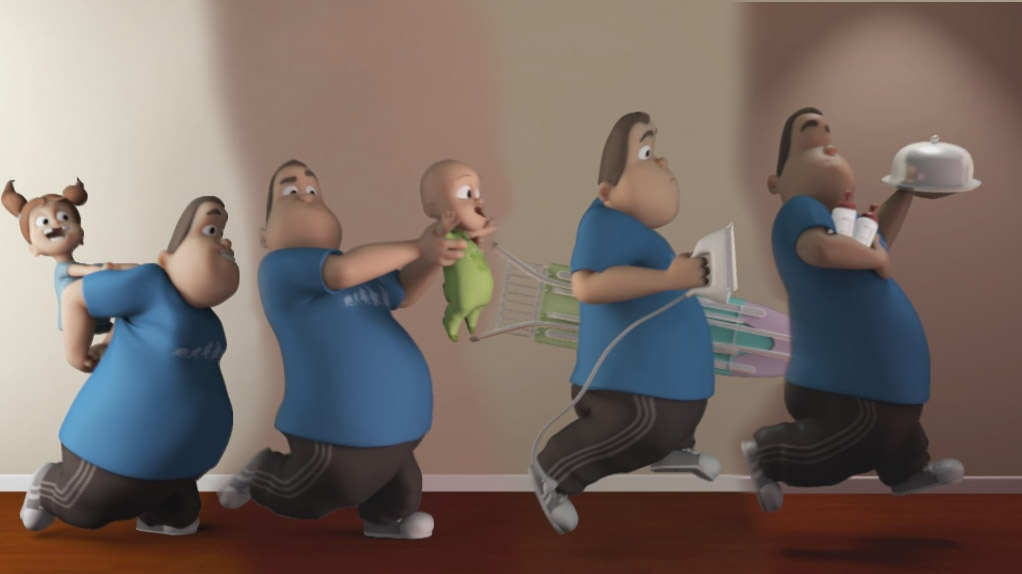
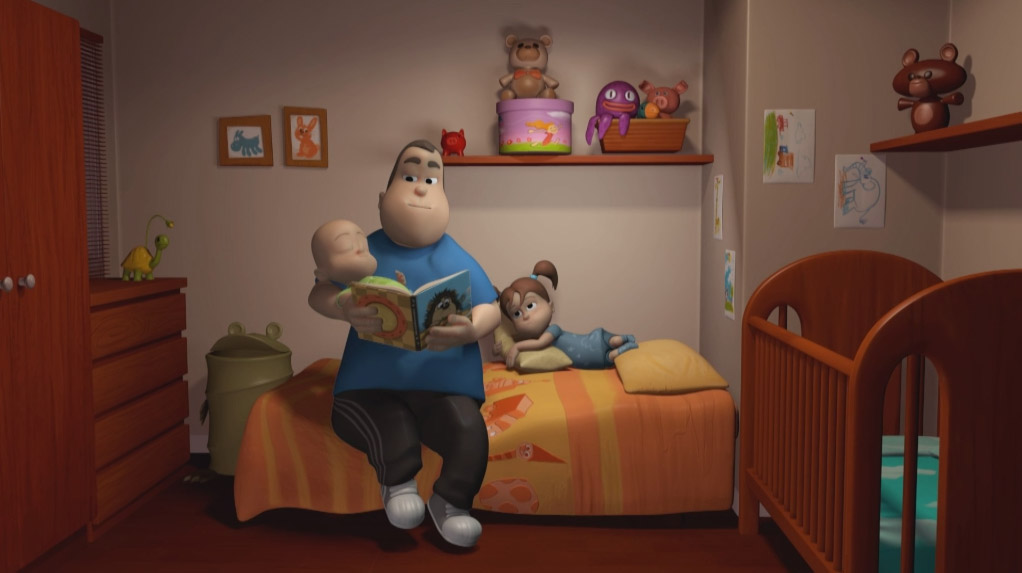
This first short film is a project with the intention to be shown at festivals. The story is about a man doing the housework and the prejudices concerning child growing. It is a simple story which treats the prejudices of men concerning housework.
The story is about a man doing the housework and the prejudices concerning child growing.
We hope our audience will like it. At the moment are closing negotiations for a second short film which will be a contract work for a client.
This project, despite being a short, is planned with the complexity that requires a larger project (corporate manuals, Gantt production diagrams, standarized folder trees and development of automatizms in Python). As discussed above, the idea is to finally create the necessary structure for larger projects.
In the evolution of the project we implemented Blender services in a renderfarm of 500 processors and we are preparing the whole documentation of the project to be published when we finish the film.
Did you implement your OWN renderfarm?
RenderFlow is our render department and offers online rendering service for several years now. We decided to adopt the service to make it compatible with the needs of mayor productions and with the guarantee of absolute confidentiality for our clients.
Have you considered existing renderfarms? What did you find lacking?
The existing renderfarms for Blender use to be public ones (so the production is not confidential), they lack to offer the possibility to refer to libraries or they simply lack render power per node or in total.

Can you share some technical details?
The typical scene from Important Things has an average of 80 referenced libraries, 300Mb and needs 40min per frame for rendering on a Dual Xeon Quad Core 2.5Ghz. In RenderFlow we can use the references which allows us to send only the changes in the scene for each render shot and not always the whole one. Furthermore we have 500 CPU available for processing and due to the fact that the rendering process does not need human intervention and that it proceeds in a closed CPD this guarantees the confidentiality of the project. I would like to announce that developments goes on and soon we will present the second version of this system.
The film has a duration of 8 minutes in format 1080p stereoscopic.
We use the blender internal render engine but we have also tested with vray (we are partners of chaos group at renderfarm level).
We have to finalize the project before 31/12/2011 so we’re busy with the last settings for render/postprod while composing the soundtrack.
The blog of the short and the documentation has not been translated to English to avoid complicating the millions of tasks that are due to do in this first project, but for the next project and for the preparation of exhibition material at least parts will be translated.
Rig demo (Spanish)
How do you use Blender for this project?
The project is entirely made with Blender except video edition which is done with Premiere because this software allows us to use hardware acceleration for composition in stereo HD.
I understand that the project isn’t done yet, but how does your team like working with Blender so far? Will your studio keep using Blender in the future?
We will finish the project before 31st of December this year. At the moment we are busy with rendering + composing of soundtrack + creating sound effects
The team felt very well with Blender after an initial adaptation process to the new method. Without any doubt we will go on using Blender in future though we have to admit that we detected some problems in the use of libraries which have to be solved. (in case you are interested, it concerns the fact that Blender “looses” links to libraries which are not encountered once you save the scene and generates the need to create the links again afterwards.)
I have to gather the final data and I will send you the final credits, the estimation of costs and any document which might help anybody else to create his own project.
Links
- Important Things Website (in Spanish)
- Plasma Studio Website


Thanks a lot! very promissing and very interesting interview. It’s gonna be very useful for the community :-)
congratulations, very good
Excellent interview. You did essentially what I was going to do, but never found the time. And you did a better job at that than I would do :)
I am found of the idea. Very promising :-)
I’m really looking forward to seeing this, partly because I love the concept behind the film, and partly to see what a real, professional studio can do with Blender. What I also found interesting is that as yet another person saying that they did everything in Blender except the final composite, this time we have been given the specific feature that pulled the user away from Blender to after effects. Yes, I know you could list dozens of features that are different between any two pieces of software, including Blender and AE, but at the end of the day, people tend to choose one or another based on only one or two features that just happen to be really important *to them*. If we know what those are between Blender and AE we can start addressing them. That’s not to say Blender should be able to do everything AE can, but if we had the 10% of core features that would cover the needs of 80% of AE users then we could really start seeing far more high end pieces done just with Blender, without trying to be 100% of Maya + 100% of After Effects.
Anyway, a great interview. Very interesting to read and thankyou very much to the producers for opening all the files to the community also! It would be great if you could share them on Blendswap to help strengthen Blender having one central repository of all open content. Rock on!
They have several videos on Vimeo detailing their compositor node trees in Blender:
“The project is entirely made with Blender except video edition which is
done with Premiere because this software allows us to use hardware
acceleration for composition in stereo HD.”
Reading WHAT is written is almost as important as understanding it: PREMIERE is not AFTER EFFECTS.
It shouldn’t be seen as a shortcoming of Blender that it isn’t a good video editor. It is a very good 3D design and animation tool.
I can understand why a graphics house would use Premiere for this phase of the process. Arguably the Blender internal editor is probably “good enough”. That is, it allows an animator to perform simple assembly work. Dedicated film and video editors are very much more powerful and offer vastly more specialist tools to assist editing.
Most modern NLEs (non-linear editors) also offer some 3D tools. They may have a more or less rudimentary particle system, they’ll certainly offer 3D digital effects and some degree of motion tracking and stabilisation. What they aren’t good at and don’t offer is 3D animation.
No-one complains when they need to use external art tools to create textures and background art in a Blender project. Let the Blender team focus on what they’re good at and not divert effort to video editing. If you need a free professional NLE, checkout the Lightworks project at Editshare.
I love the style and the lighting! However, the character animation needs…a lot of work…
looks funny. as in humorous
Thank you very much everyone for the comments of encouragement. We hope to cover 10% of the viewers with the film. The process has already been a reward for us.
Just wondering: What is the use of keeping libraries in the blender files, that are not linked? I could link the libraries just in time if I really need objects from that library?