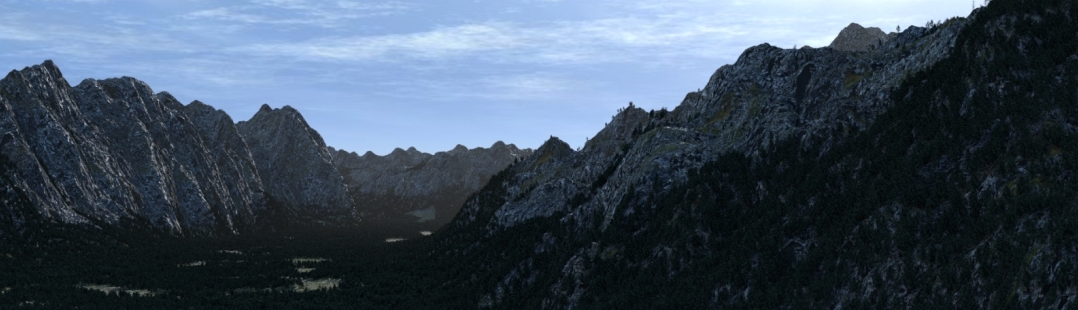

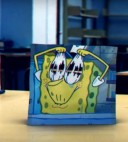
 Here's a bunch of ID's we made at Astral Media, a big television company in Canada, for Vrak.TV, a very popular channel for teenagers here in Quebec. We modeled, animated, and textured all the paper, frame by frame, using Blender.
We then made the compositing in AfterEffects, adding the many render layers over backgrounds we shot.
Hope you guys like it!
ID Vrak.TV from Nicolas Ménard on Vimeo.
Credits
Client: Astral Media / Chaines Télé Astral
2D/3D animation, photos: Maxime Dussault, Nicolas Ménard
Realisators: Raphël Bélanger et Fred Dompierre
Director of postproduction: Marcuse Olivier
Compositing: Marc-André Lavoie
Sound: Bernard Poirier
24 Comments
That's some nice stuff! Quite humorous as well, great work.
i've never seen a thing like that; good ideas!
Cool. Like.
En un mot, "super-boulot" !
Tis is combination of stop and 3d animation? Nice idea.
Very nice work!
Stop motion in 3D :)
I love your other works too
Très bonne idée et réalisation.
Not being in the biz, I don't know what "ID" means, but I like to believe it is pronounced like "idée".
wow! really nice =D
really great work. Submit it here http://www.stashmedia.tv/
to see more Blender on the pro league. ;)
great use of blender:)
good compositing too looks very fresh..thumbs up
@Zecc
i think the ID stands for identity/ identification...usually tv stations would use them as jingles between stuff and that the viewer can identify the station they are on...just guessing here tho
Great work. Really love the visuals! :)
Congrats!
Wow. Looks cool, but it seems like it would have been just as much work as real stop motion.
Thanks for the nice comments guys!
To answer a few questions:
-ID stands for Identities, Nixon was right in his definition of the term!
-We could have made the same thing in real stop-motion, but in television work, we need to have the optimal versatilty over our projects, so if there's modifications to do, we don't have to do it all over again. So that's why we used blender to do it!
Totally crazy! Love it!
WOW that was cool!
Fascinating!
Inspiration must surely have been 'Fast Film' by Virgil Widrich
http://www.youtube.com/watch?v=Td6UObEEaQQ
Get it on onedotzero no.4 - all their productions are full of quality work.
http://www.onedotzero.com/dvd.php?id=2810308
Doesn't take away from the quality of that Blender work though, awesome :-)
I work for a small digital channel in Toronto, Canada and I've been steadily integrating blender into my workflow over the last couple of years.
I don't have anything this extensive, usually just logos and 3d text integrated with motion graphics, but I use it where I can. I'm glad to see that there are others out there that are doing the same. Blender is such a great example of what can be accomplished by a community.
What did you use for 3d motion tracking?
Merci pour partager! (I think that's correct)
I can't help but wonder if the pieces of paper had bones, or if it was just a lot of shape keys.
If it hadn't been posted on BN, I never would have known it wasn't just stop motion. This is great.
@Wray Bowling: Probably bones. Shape keys only translate vertexes in a straight line from one position to another, whereas bones would allow you to rotate parts of the mesh (like when the paper is folding).
Some of the crinkling and folding I would guess was done with animated displacement texture or lattice, perhaps? There's a part I noticed with several sawtooth shaped crinkles 'traveling' down the paper. Bones wouldn't be the first thing I'd try for accomplishing that bit.
@Rob Cozzens: With the added complication of video frames on the paper, stop-motion animation of printed frames might actually be harder.
Hey guys,
to answer some technical questions: the process was quite simple. No bones, no shape keys.
We simply modeled a paper shape, applied a video texture to it, and duplicated the same shape for each frame, modifying frame by frame the position of the flaps.
Once the low poly animation was done, we subdivided each frame and used the sculpt tool to quickly add details to the paper shape, so it's different each frame, to keep the stop-motion look of real paper.
We worked in 15 frames by second.
Also we didn't use any 3D tracker, just our eyes, ahah. For the boat, for exemple, it was tracked in Blender frame by frame with a plane I used as a guide. So after sculpting a frame, I placed the plane so the perspective match the position of the boat.
Hope it helps!
@Nixon: Thanks for your answer.
@Nicholas: I suppose I would have modeled each frame individually too, but without a camera tracker behind? Not so sure...
You did a good job.
Often we forget the little guy, the SMB, in our discussions of the comings and goings of the Internet marketing industry. Sure there are times like this when a report surfaces talking about their issues and concerns but, for the most part, we like to talk about big brands and how they do the Internet marketing thing well or not so well.
onlineuniversalwork