
Red Hat High 2007

 Last week, the second Red Hat High technology camp ended. You may recall that we reported around this time last year about 3 members of the Blender community traveling to Raleigh, North Carolina to teach at the first ever Red Hat High technology camp. This year, we had 4 Blender instructors from the community, and based on the incredible work produced by students last year, we had a better idea of what to expect. We decided to put greater emphasis on animation this year and the students rose to the challenge, blowing all of us away.
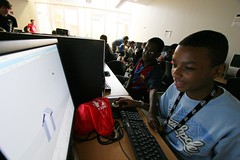 The Digital Animation track at this year’s camp started with 15 students, dwarfing the numbers in the other tracks of Audio, Illustration, Digital Darkroom, and Programming. Fortunately, we had the right instructors for the job. Jonathan Williamson and I returned from last year’s camp, and we added two award-winning Blender animators to the group: Bassam Kurdali (director of Elephants Dream) and Sam Brubaker (2006 Suzanne Award winner for Infinitum). The students used us to their full advantage, producing some absolutely stellar work. A roughly 4-minute assembly of their work is below:
[ev type=”flashvideo”” width=”480″ height=”360″ data=”http://www.handturkeystudios.com/rhh/rhh-blender.flv” image=”http://www.handturkeystudios.com/rhh/play-button-328×240.jpg” clicktext=”Red Hat High – Digital Animation Track”][/ev]
 It’s important to realize just how far this group of 13- to 15-year-old students came in the short span of just 5 days. Most of these students had never used any 3D software before and only one had ever heard of Blender prior to the camp. Over the entire week, they only had about 20 total hours to learn the basic concepts of 3D modeling and animation, familiarize themselves with Blender’s interface, come up with an idea for a project, and execute it. By the end of the camp, these students were producing work that was well beyond the quality most people would expect. In fact, they were able to prove this on their field trip to the School of Communication Arts at Digital Circus in Raleigh. This year’s camp Director, Greg DeKoenigsberg, wrote about it on Red Hat Magazine:
When the kids reached the 3D Animation classroom, they were very impressed by Maya — until one of them asked for a free copy. “A full license of Maya costs $7000,†the instructor said, which elicited an outraged reaction from the kids. “But Blender is free!†they cried in unison.
Then the teacher started to show them some of the things Maya could do, and he was clearly surprised at the kids’ clueful responses. “These are vertices,†he’d say, and then they’d say “yeah, we’ve done that.†“Okay, this is texturing.†“Yeah, we’ve done that too.†“Okay, this is FK and IK.†“Yeah, forward and inverse kinematics. We’ve learned about that.â€
For me, that moment has been the highlight of Red Hat High so far: standing there behind these kids, watching the professor become more and more frustrated at his inability to stump them — when they’d been in class for three days.
Hearing this story made us teachers have the biggest, stupidest grins on our faces. I really wish I could have been there to see that.
 The students knew this for a reason, though. They worked hard; challenging both themselves as well as us by asking tough questions and setting ambitious goals for their projects. A few students used some pre-rigged characters for their animations (including ManCandy and a coffee/flour sack created by Bassam). Others built their entire scenes from scratch or made use of advanced tools like arrays, dupliframes, particles, and even the fluid simulator. And the students in our track were not the only ones making great work. The Audio track students produced very strong music tracks and podcasts. The students in the Illustration track produced a short anthology of comic book pages. The Programming track students developed a Google Gadget to compute their grades. And the students of the Digital Darkroom track modified and improved dozens of the nearly 5000 photographs they took over the course of the week. Without a doubt, we walked away from camp this year thoroughly impressed… again.
Red Hat has planned on expanding this program from the beginning, so right now we instructors are working to finalize a curriculum that may be used and adapted by other teachers. Part of this will involve me giving a QuickTake presentation about Red Hat High at this year’s SIGGRAPH conference in San Diego. Blender Nation will report on that as it develops. Hopefully in the years to come we will see more programs like Red Hat High sprouting up all over the globe. And where ever that happens, we can be sure that Blender will be a big part of it.
More Information




This is amazing. I’m sure the result and the kid’s enthusiasm are also a tribute to the quality of the teachers!
Very nice work!
I’m curious to see more of your animations, all of you :D
Well done to all involved.
The quality of these clips is amazing, considering the time available.
Great!
Impressive. Only a couple of days starting from zero. Great kids and not to forget teachers.
Open source opens your eyes. I wish I could have been there when the kids said, “But Blender’s free!” Puts a smile on my face thinking about it.
Wow its really great what they have learned in so little time :)
this is so cool… I want to be part of it in the next 2 years!
HA HA!! nice to read something like this :D good work teachers and kids, if I ever hear a kid mentioning IK I will be very impresed too :o The open source education is very important for kids, they need to know from the begining that there are alternatives
Good work by some new animators…
I’d also like to compliment the teachers in allowing the kids to run with their ideas.
It is very clear that each student was given complete freedom, both artistically as well as with content.
I would say that part of the reason that the team learned so much is because they were allowed to cover such a large range of capabilities within the platform, and were allowed to stretch their own understanding of the virtual world they were exposed to.
Red Hat’s off to the teachers, and to the students!
The seeds you have sewn will grow rich fruits….
parafan
And once again, I’m from raleigh and there wasn’t any notice of this beforehand. :(
Right.. so obviously next year I need to talk to Red Hat High directly. Oh, and all this work is astounding! I’ll look forward to being there next year! :D
@Bmud: I agree, I was surprised by it as well..
Really awesome work! For such a short period of time to be exposed to Blender for the first time and come out with that work is awesome!
Congratulations to all the teachers! Looks like you did really well!
pretty awesome stuff they did there
Wow… I feel so discouraged… these kids have achieved more in animation than I’ve achieved in 2-3 years…
What a week! Helping kids with blender in the morning, and helping each other with blender in the afternoon. Great fun!
Bmud, If you are in Raleigh, I will also be there at NCSU for the next four years!
Red Hat did a good deed by teaching kids about open source software. The world now has a slightly brighter future!